Algorithms Know What You've Watched — But Not What You Actually Want

There's a specific kind of exhaustion that hits when you open Netflix, scroll for twenty minutes, and somehow end up watching nothing. The rows of thumbnails blur together. The "Top Picks for You" section feels less like a suggestion and more like a mirror you didn't ask to look into. And somewhere between the third autoplay trailer and the fifth "Because You Watched" category, you close the app and just go to bed.
This isn't a rare experience anymore. It's practically a shared cultural ritual — and a growing number of people are deciding they're done with it.
The Personalization Paradox
Here's the irony at the center of modern streaming: the smarter these platforms get, the more trapped their users feel. Recommendation engines are built to keep you engaged, and they're genuinely impressive at it. They track what you watch, how long you watch it, where you pause, and what you abandon after seven minutes. They build a profile of you that's disturbingly accurate.
But accuracy isn't the same as satisfaction. When an algorithm learns that you watched three true crime documentaries during a rough week in February, it doesn't understand why you watched them. It just knows you did — and now your entire homepage skews dark and investigative for the next six months. The system optimizes for clicks, not for the kind of serendipitous discovery that turns a random Tuesday night into a genuinely memorable experience.
Psychologists have a term for this: choice overload. When you're presented with too many options that all feel tailored specifically to you, decision-making becomes harder, not easier. The algorithm was supposed to solve the paradox of choice. Instead, it's amplifying it.
Going Old School, On Purpose
So what are people doing instead? Increasingly, they're going analog — or at least, analog-adjacent.
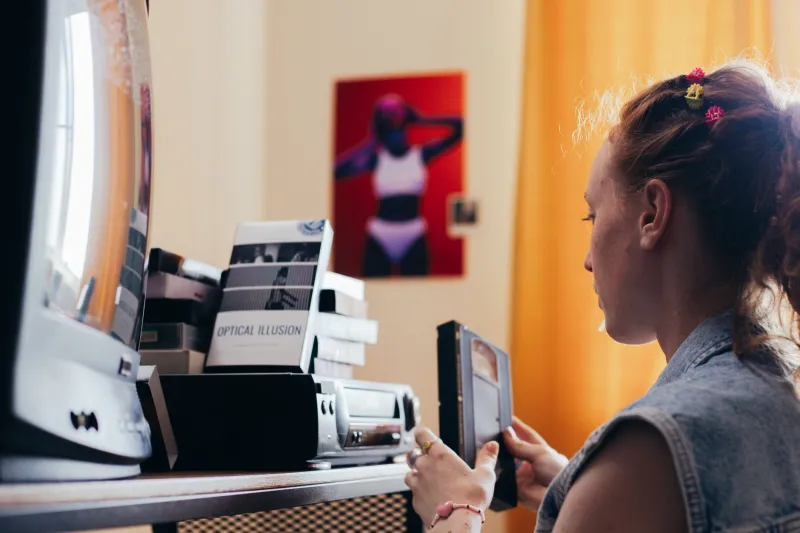
Physical media stores, which most of the industry wrote off years ago, are quietly seeing renewed interest. Vinyl's resurgence got all the press, but DVD and Blu-ray collecting has been creeping back into the conversation too. There's something about walking into a store, picking up a case, and reading the back of it that scratches an itch no algorithm can reach. You're not being served a recommendation — you're stumbling onto one.
Niche internet forums are having a moment too. Subreddits dedicated to specific genres, Letterboxd communities built around particular directors or eras, Discord servers where film buffs argue passionately about overlooked gems — these spaces are thriving precisely because they're human-powered. The recommendations come with context, personality, and sometimes a little friendly argument. When someone in a forum tells you to watch a specific 1970s Italian thriller, they're not doing it because an engine calculated a 94% match. They're doing it because they genuinely loved it and want you to feel the same thing.
Word-of-mouth, the oldest entertainment marketing tool in existence, is also making a quiet comeback. Not influencer word-of-mouth — not the kind where someone gets paid to casually mention a show — but the real thing. A coworker who won't stop talking about a limited series. A family member who texts you out of nowhere saying you have to watch something. That kind of recommendation carries weight that no push notification ever could.
When Personalization Starts to Feel Invasive
There's another layer to this that doesn't get talked about enough: the creep factor.
For a lot of viewers, hyper-personalized recommendations have started to feel less like helpful nudges and more like surveillance with a friendly interface. The data these platforms collect is extensive, and even if it's technically anonymized or buried in a terms-of-service agreement nobody reads, people are increasingly aware that their entertainment habits are being catalogued, analyzed, and monetized.
That awareness changes the experience. Watching something on a streaming platform starts to feel less like a private choice and more like a data point being contributed to a system you don't fully understand. Some viewers describe feeling "watched while watching" — a low-level discomfort that's hard to shake once you start noticing it.
The backlash isn't anti-technology, exactly. It's more of a boundary-setting exercise. People aren't abandoning streaming altogether — they're carving out spaces where they feel like they have genuine agency over what they consume, rather than being gently steered by an invisible hand.
The Rediscovery of Browsing
One of the most underrated pleasures of the pre-streaming era was browsing without a destination. You'd walk through a video rental store with no specific movie in mind, let the cover art catch your attention, flip the case over, and make a gut-call decision. The experience was inefficient by every measurable standard. It was also kind of wonderful.
That experience is being reconstructed in unexpected places. Some independent bookstores have started hosting film recommendation nights. Libraries — actual public libraries — are reporting increased interest in their DVD collections. There are even apps being developed specifically to remove personalization from the equation, offering random or genre-shuffled recommendations that deliberately ignore your watch history.
It sounds counterintuitive in an era built on optimization. But there's real demand for it. The appeal isn't nostalgia for its own sake — it's about reclaiming the feeling that you chose something, rather than having something chosen for you.
What the Platforms Are Missing
Streaming services aren't oblivious to this. Some have experimented with "shuffle play" features and curated editorial picks from human programmers rather than automated systems. The results have been mixed, partly because these features often feel like algorithm-lite rather than genuinely different.
The harder truth is that what people are craving isn't really a technical fix. It's a relationship with entertainment that feels less transactional. When a friend recommends a movie, the recommendation comes wrapped in trust, shared history, and genuine enthusiasm. No recommendation engine, no matter how sophisticated, has figured out how to replicate that.
That gap — between what technology can optimize and what human connection can provide — is exactly where this quiet rebellion is taking root. And it doesn't look like it's slowing down anytime soon.
Maybe the future of entertainment discovery isn't smarter algorithms. Maybe it's just asking someone you actually know what they've been watching lately.